Material procedure
Confirm that the dryer can support the exact temperature-and-time procedure published for your filament brand and grade.
Check drying guidanceTHE FILAMENT WORKBENCH
Compare documented models by material requirements, spool fit, capacity, and the way you print. Then keep the decision useful with a drying reference and private spool log.
Researched comparisons · Manufacturer sources · Practical tools
THE SHORT ANSWER
A filament dryer is a controlled heated chamber built to prepare 3D-printing filament with a documented temperature-and-time process. The active process is intended to reduce moisture held by the material. A sealed dry box mainly helps protect a prepared spool from the surrounding air; some systems combine both roles.
You do not need to heat every spool by default. Start with the instructions for the exact filament, an observed printing problem, and the routine you can repeat. If the material already prints consistently, better filament storage or a printer-setting diagnosis may be the more useful first step.
Unsure which job you need to solve? Compare a dry box versus a filament dryer, or decide whether a dryer is worth it for your setup.
A FIVE-CHECK SHORTLIST
There is no universal winner. The best choice is the one whose documented capabilities match your material, reel, printer, and routine.
Ready to narrow the catalog? The Finder explains every match and keeps unknown specifications visible.
Use the Dryer FinderSTART WITH YOUR MATERIAL
Use these collections to compare by everyday materials, capacity, higher-temperature capability, budget, and storage role.
Compare dryers for everyday materials, with the temperature and storage checks that make the choice useful.
02 / 6 OPTIONSCompact drying options for one printer, a small bench, or a single roll that needs attention.
03 / 10 OPTIONSCompare two- and four-spool dryers for multiple materials, several printers, or a more organized bench.
04 / 5 OPTIONSCompare verified dryer ranges against an exact engineering-filament process, reel limit, load, and operating mode.
05 / 5 OPTIONSCompare simpler dryers and choose the features your first drying setup actually needs.
06 / 9 OPTIONSProtect prepared spools between prints with closed storage boxes, vacuum bags, and a repeatable organization routine.
DOCUMENTED OPTIONS
As an Amazon Associate, we earn from qualifying purchases. Buying through our links may earn us a commission.

SUNLU / DRYING
A four-spool station with one shared temperature setting, circulation fans, and humidity-controlled operation.

SUNLU / DRYING
A single-spool dryer with a 70°C ceiling and a documented 210 ×85mm reel envelope. Check the fan-equipped revision.

Creality / DRYING
A two-spool hot-air dryer for keeping two rolls ready at one shared temperature.
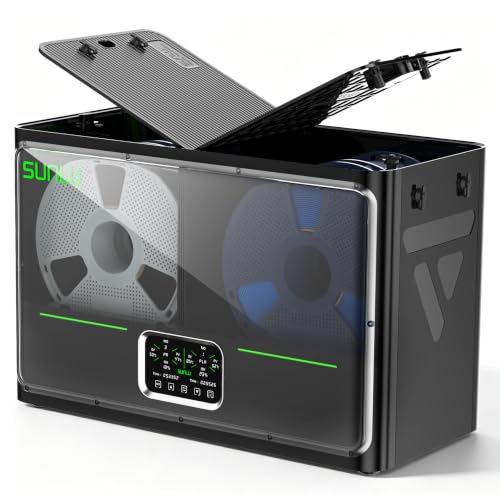
SUNLU / DRYING
Two independently controlled chambers let four spools share a station while using different drying settings.
Selection is based on documented specifications and workflow fit. We have not independently bench-tested these products. Read our comparison method.
LESS GUESSWORK. MORE MAKING.
Use these tools for decisions and records you will revisit as materials and projects change.
THE QUESTIONS BEFORE THE PURCHASE
Separate a useful moisture fix from a purchase your setup may not need.
Read the guide FIELD NOTE / 02Look at storage, symptoms, and manufacturer guidance before deciding.
Read the guide FIELD NOTE / 03Understand the difference between drying wet filament and keeping it dry.
Read the guideTHE NEXT PRINT STARTS HERE
Save a material, record what you tried, and pick up where you left off.